

At the end of summer, many homeowners stop opening their external bifold doors every day. The doors remain closed for longer, the temperature drops, and the first cold snap exposes weaknesses that were easy to miss during warmer weather.
Suddenly, the panels need lifting. The handle takes two hands to operate. The first panel drags across the threshold, or the doors refuse to close cleanly.
This does not necessarily mean the doorset needs replacing. In many cases, the cold has revealed a combination of minor alignment movement, stiffened seals, contaminated rollers and moisture in the bottom channel.
The right response is usually to diagnose the cause, re-set the doorset and replace only the components that have genuinely worn.
What the first cold snap does to an external bifold doorset
External bifold doors are precision mechanical systems. Their frames, glass, seals, hinges, rollers and locking points must work together within relatively tight tolerances.
When the temperature falls, several small changes can happen at the same time.
1. Seals become stiffer and may have taken a set
Weather seals are designed to compress against the frame and between the panels. Over time, rubber and flexible gaskets can become compressed in one position, particularly if the doors have been closed for several weeks.
This is known as taking a set.
When the temperature drops, the material becomes less flexible. A seal that was already tired may no longer spring back properly, while a compressed seal can press harder against the panel edges. The result may feel like a door that is catching or sticking at the start of its movement.
Typical signs include:
- Increased resistance at the leading edge
- A draught around one panel rather than the complete doorset
- A seal that looks flattened, split or loose
- Rattling or poor contact when the door is closed
- The door needing more force to pull into position
Replacing a worn seal can restore the weather performance, but only if the panel alignment is also correct. A new gasket cannot compensate for a dropped or twisted panel.

2. Panels can drop slightly as the frame and glass cool
A bifold panel may only move by a few millimetres before the change becomes noticeable. As the frame and glass cool, their dimensions and relative clearances alter. Seasonal movement can expose an alignment issue that was already developing.
The result can be a panel that:
- Drags over the threshold
- Catches at the top of the opening
- Sits lower on the handle side
- Meets the adjacent panel unevenly
- Requires lifting while the handle is operated
- No longer lines up cleanly with the locking points
A door that will not lock because the panel has dropped is first and foremost a mechanical and alignment fault. The handle or lock may be working correctly, but the panel is no longer presenting the correct position for the locking points to engage.
This is why repeatedly forcing the handle is a poor solution. It can transfer unnecessary load into the lock, hinges, keeps and panel connections.
Why cold weather makes rollers feel heavy
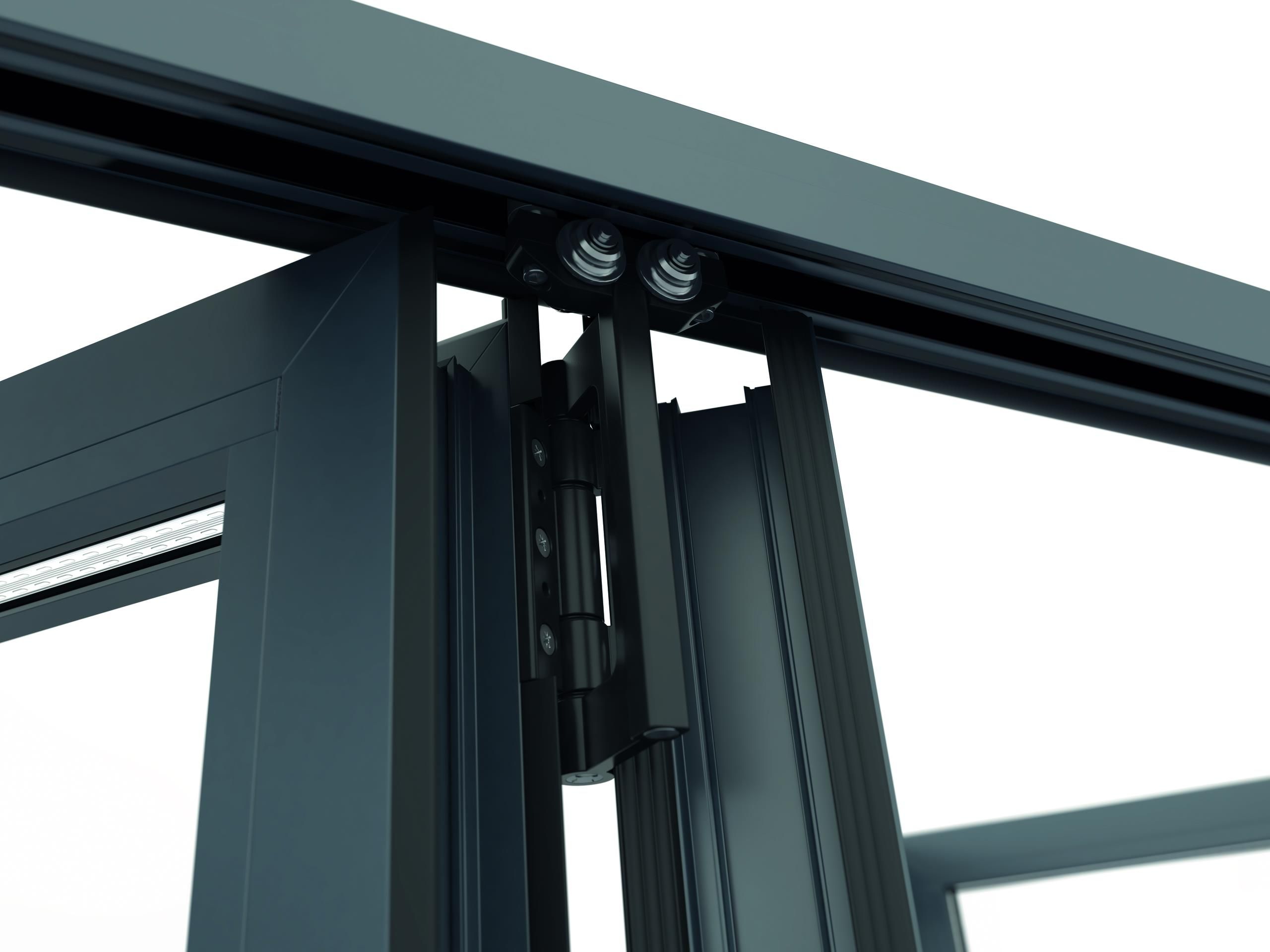
Bifold doors rely on running gear to carry and guide the weight of the panels. Depending on the doorset, this may include bottom rollers, top guides, hinges, pivots and connecting brackets.
Cold weather can make an existing roller problem much more obvious.
Cold-thickened lubricant
Old lubricant can become thicker as temperatures fall, particularly when it has mixed with dust and fine grit. Instead of helping the bearing move freely, it can create additional drag.
A roller that was already beginning to wear may therefore feel noticeably worse after one cold night. The doors can become heavy to start, noisy as they travel, or reluctant to fold.
Wear inside the roller bearing
Rollers can develop flat spots, excessive play or damaged bearing surfaces. If a panel has been misaligned for some time, the roller may also have been carrying load unevenly.
Common symptoms of a roller fault include:
- A repeating knock or rough point during travel
- One panel moving differently from the others
- A visible wobble at the bottom of the panel
- Resistance that remains after the track has been cleaned
- A door that improves briefly after lubrication, then becomes heavy again
This is where bifold door rollers repair requires more than simply spraying lubricant onto the track. The roller, its bracket, the panel position and the track must be assessed together.
Condensation can freeze in the bottom channel overnight
When warm, moist air meets cold metal and glass, condensation can form around the threshold and bottom channel. If temperatures fall below freezing overnight, that moisture can freeze around grit, debris and the running gear.
Even a thin layer of ice can act as a wedge beneath a roller.
The door may feel completely stuck first thing in the morning, then appear to improve as the temperature rises. That does not mean the problem has disappeared. Repeated freezing and thawing can leave behind residue, corrosion and further contamination.
Before operating the doors in freezing conditions:
- Do not force the panels through ice
- Remove loose dirt and leaves from the channel
- Allow frozen moisture to thaw naturally
- Dry the accessible channel where possible
- Check whether the roller still runs smoothly afterwards
If the door continues to drag once the channel is clean and dry, the underlying issue is probably alignment, wear or damage rather than the frost itself.

How to tell a routine adjustment from a real fault
Not every cold-weather change means a major repair is required. However, continued force can turn a routine adjustment into a component failure.
It may be a routine adjustment when:
- The panel catches at one consistent point
- The doors worked well before the temperature dropped
- There is no grinding, knocking or excessive play
- The track is clear and the rollers look intact
- The problem is limited to a small change in panel position
- The door closes correctly once gently supported or realigned
A professional bifold door alignment adjustment may be enough to restore the correct panel height, spacing and contact pressure.
It may be a genuine fault when:
- You need to lift the panel every time you close it
- Two hands are needed to operate the handle
- The door drops again after adjustment
- A roller makes a rough or repetitive noise
- The panel rubs at both the top and bottom
- The track is damaged or distorted
- Seals are split, loose or permanently compressed
- The doors will not close or lock even after the channel is clear
A specialist assessment distinguishes between a simple re-set, a worn component and a wider doorset issue. The Pro-Lock team checks the panel position, frame geometry, glazing support, hinges, rollers, tracks, seals and closure points as one connected system.
Why re-setting and servicing beats replacing the doorset
A doorset that sticks in winter is often treated as a replacement opportunity. That can be an expensive overreaction.
If the frame remains serviceable and suitable parts are available, restoration can involve:
- Re-setting panel height and alignment
- Correcting the cause of a dropped panel
- Servicing or replacing worn rollers
- Replacing tired weather seals
- Correcting hinge or guide wear
- Cleaning and checking the track
- Re-establishing correct closure pressure
- Checking the doorset against relevant manufacturer tolerances
This approach can prolong the life of the existing doors, improve everyday operation and reduce the risk of a small seasonal fault becoming a larger winter repair.
Pro-Lock does not sell new doors. That means the recommendation is based on the condition of your existing external bifold doors, not on a replacement sales target.
For more information, see the bifold door services and how the Pro-Lock assessment works.
Transparent assessment and repair pricing
A proper diagnosis is important because adjusting the wrong component can provide only temporary relief.
- £79 assessment
- A written itemised quote is always provided before any work
- The assessment fee is credited against the repair cost
- 12-month warranty on all repair work
The assessment covers the complete doorset rather than just the symptom. No repair work is carried out during the assessment. The findings and recommended repair route are explained clearly so you can make an informed decision.
External bifold doors only
Pro-Lock repairs and services external bifold doors only, including doors made from:
- uPVC
- Aluminium
- Timber
- Hybrid materials
Internal bifold doors (including wardrobes, cupboards, storage doors or room dividers) are not covered. If your problem relates to an internal system, please seek an internal-door specialist. For weather-exposed patio and garden doors, contact an external bifold door specialist.
Bifold door repair across ten counties
Pro-Lock provides external bifold door repair across exactly ten counties:
- Norfolk
- Suffolk
- Cambridgeshire
- Bedfordshire
- Essex
- Hertfordshire
- Surrey
- Kent
- East Sussex
- West Sussex, including Worthing and the coastal areas around Chichester Harbour, plus Crawley, Horsham, Arundel, Bognor Regis, Littlehampton, Shoreham-by-Sea and Midhurst
London is excluded from coverage. You can check the full service area before arranging an assessment.
Stop a cold-weather adjustment becoming a winter breakdown
If your external bifold doors have suddenly become heavy, are dragging, or need lifting to close, do not keep forcing them through the problem.
A clean track may resolve surface contamination, but a persistent fault may require bifold door maintenance, a precise re-set or bifold door rollers repair. Early diagnosis is usually more practical and cost-effective than waiting for a roller, hinge or locking point to fail completely.
If you are searching for bifold doors repair near me, contact the Pro-Lock team today:
Tell us what the door is doing, where it is catching and whether the problem appeared after the temperature dropped. The Pro-Lock team will help establish the next practical step towards restoring smooth, reliable operation.