
_edited.png)


The Extension Hangover: Why Your New Bifolds Are Failing Already
- Matt House
- Jul 7
- 5 min read

You’ve spent months living in a construction zone. You’ve endured the dust, the endless brews for the builders, and the dwindling bank balance. But finally, your stunning new extension is finished. The centrepiece? A set of sleek, wide-span aluminium bifold doors that were supposed to "bring the outside in."
But three months later, the honeymoon period is over. The doors are catching on the frame. The lock requires a Herculean effort to turn. There’s a mysterious whistle of air coming through the seals.
Welcome to the "Extension Hangover."
At Pro-Lock, we see this every week. Homeowners across Norfolk, Suffolk, Cambridgeshire, Essex, Kent, and East Sussex call us in a panic because their expensive new Origin, Schuco, or Smart Systems doors are failing before the first birthday of the extension.
The good news? It’s rarely a "broken" door. It’s usually an installation hangover. Here is why your new bifolds are acting up and how we restore them to their former glory.
1. The "House Settling" Myth
Builders love the phrase "the house is just settling." While it’s true that new foundations and timber-heavy extensions will move slightly as they dry out and take the weight of the structure, a bifold door is a precision instrument.
If your extension moves by just 2mm or 3mm, a high-performance system like Reynaers or ALUK can go from "gliding" to "grinding."
The Real Issue: Structural Tolerances
Most general builders are fantastic at brickwork and roofing, but they often lack the specialist knowledge required for bifold structural preparation. Common errors include:
Inadequate Lintels: If the steel lintel above the doors wasn’t beefy enough, it can "deflect" (sag) under the weight of the masonry above. This puts direct pressure on the top track.
Foundation Shortfalls: If the concrete slab doesn't extend far enough or isn't perfectly level, the bottom track can dip, causing the panels to misalign.
Lack of Expansion Gaps: Aluminium expands and contracts with the sun. If the builder fitted the frames too tightly to the brickwork without proper foam and sealant allowances, the frame will bow in the summer heat.
✅ Pro-Lock Solution: We don’t just "force" the door shut. We assess the level of the tracks and the frame's squareness to identify if the issue is structural or mechanical.
2. Why General Builders Struggle with Precision
A standard external door has a tolerance of about 5mm to 10mm. A bifold door system? You’re looking at 1mm to 2mm of tolerance across a 5-metre span.
Many general contractors install bifolds using a standard spirit level. While fine for a garden wall, it’s not enough for a five-panel Beaufort system. If the bottom track is out of level by even 1.5mm over the width of the opening, that error is magnified by the time it reaches the top of the panels. The result? Doors that "run away" from you or won't meet the locking keeps properly.

3. The Dark Art of "Toe and Heeling"
This is the single most common reason for bifold failure in new extensions. Bifold panels are incredibly heavy. To stop them from sagging under their own weight, the glass must be "packed" inside the frame.
This process, known as Toe and Heeling, uses plastic spacers to transfer the weight of the glass toward the hinge side of the door.
The Builder's Mistake: Many builders simply drop the glass into the frame and "bead" it without the correct diagonal bracing.
The Consequence: Over the first few months, the door panels "drop" or sag. The door becomes "cross-legged," meaning it hits the bottom track or the side jamb before it’s fully closed.
If your doors are dragging on the track, it’s almost certainly a glass-packing issue rather than a hardware failure. We specialize in resetting these panels to ensure the weight is distributed exactly as the manufacturer intended.
4. Post-Construction Grit: The Silent Killer
An extension is a messy business. Brick dust, plaster splatter, and render grit are the natural enemies of bifold rollers.
Even if your builder was tidy, microscopic dust finds its way into the stainless steel tracks and the internal bearings of the rollers. Once that grit gets inside a Schuco or Reynaers roller assembly, it acts like sandpaper. It chews through the nylon or stainless steel wheels, leading to a bumpy, noisy operation that eventually snaps the hardware.
✅ Pro-Lock Tip: Never use grease or WD-40 on your tracks to "fix" a sticking door. It just creates a sticky paste that traps more grit and accelerates the wear.
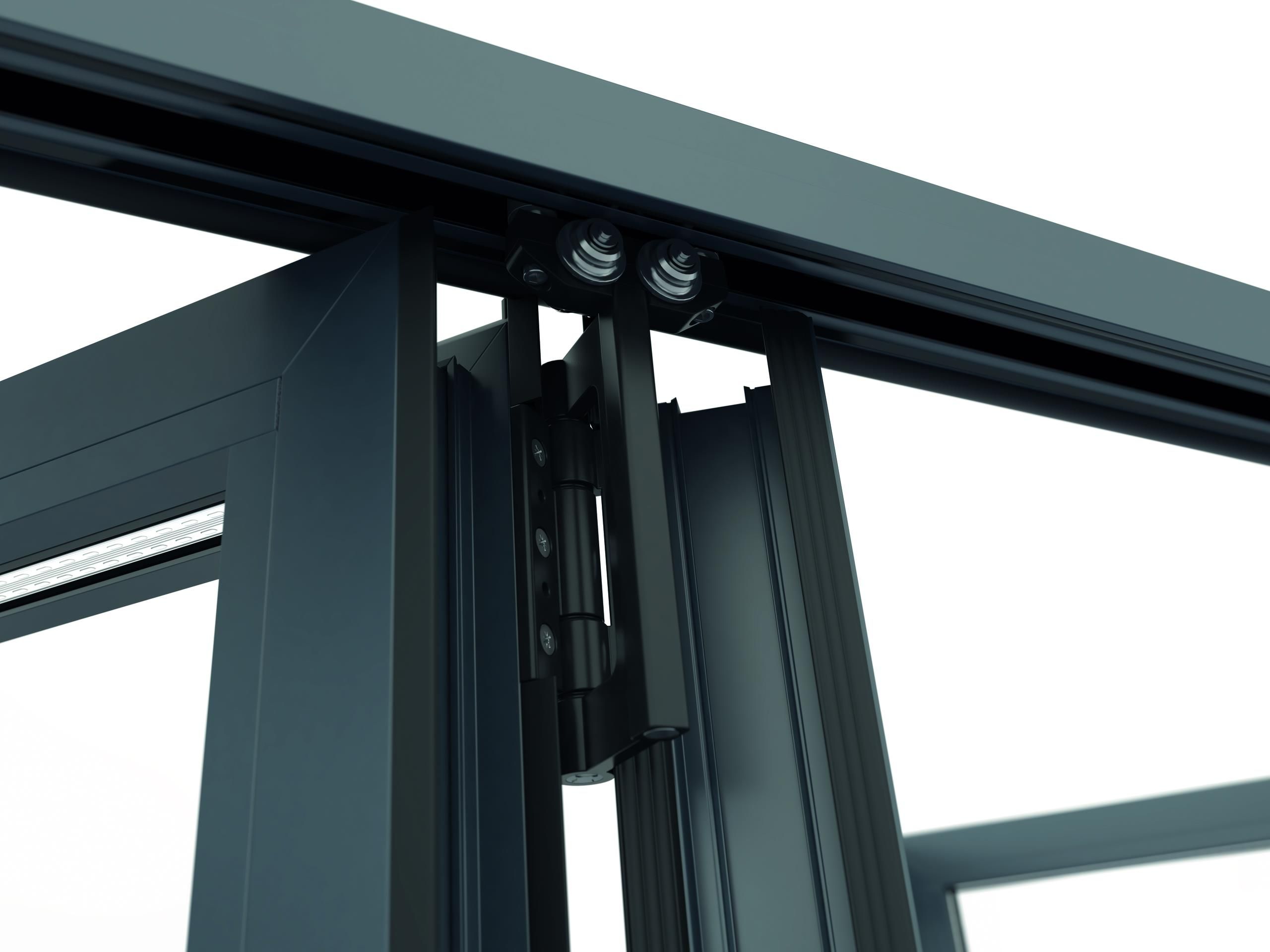
5. Misaligned Locking Mechanisms
When a door isn't perfectly square, the multi-point locking system won't line up with the "keeps" in the frame. You might find yourself having to lift the handle with both hands or pull the door toward you with your foot to get the key to turn.
Stop doing this immediately.
Forcing a bifold lock puts immense pressure on the internal gearbox. These gearboxes are the "brain" of the door, and they are expensive to replace. If you continue to force a misaligned door, the gearbox will eventually "shatter" internally, leaving you with a door that is either permanently locked or dangerously insecure.
We specialize in bifold door lock repair and can often realign the system to make the lock "flick" over with a single finger, just as it was designed to do.
Specialist Knowledge for Premium Brands
At Pro-Lock, we aren't "jacks of all trades." We have spent years mastering the mechanical intricacies of the UK's leading bifold brands. Whether your extension features Origin, Schuco, Beaufort, ALUK, Reynaers, or Smarts (Visofold), we understand the specific adjustment points and hardware requirements for each.
Each brand has its own quirks. For example, Origin doors have a very specific lead door alignment, while Schuco systems require surgical precision in track cleanliness. We carry the specific components and tools required for these premium systems, ensuring a first-time fix in the majority of cases.
Why Choose a Specialist Over Your Original Builder?
It’s tempting to call your builder back to fix the doors. After all, they installed them. However, if they didn't have the specialist tools or training to install them correctly the first time, they are unlikely to have the niche expertise to "reset" them now.
Most builders will try to "adjust" the hinges to mask the problem. This is a temporary fix that often runs out of adjustment range within a year. Our approach is to restore and realign, going back to the fundamentals of the installation to ensure long-term performance.
The Pro-Lock Promise:
Repair Over Replacement: We don't sell new doors, so our advice is 100% unbiased. We want to save your existing doors, not sell you a replacement.
Transparent Pricing: We charge a flat £79 assessment fee. We will visit your home, diagnose the issue, and provide a fixed written quote.
Financial Advantage: We are not VAT registered, meaning you do not pay VAT on our services, an immediate 20% saving.
Peace of Mind: We provide a full maintenance check as part of our service, checking all seals, locks, and rollers for potential future issues.
Our Service Areas
We establish a strong local presence across the South East and East Anglia, providing rapid response times to:
Norfolk: Norwich, King's Lynn, Great Yarmouth, Cromer, Dereham, Wymondham.
Suffolk: Ipswich, Bury St Edmunds, Newmarket, Lowestoft, Felixstowe, Sudbury.
Cambridgeshire: Cambridge, Ely, Peterborough, Huntingdon, St Neots, Wisbech.
Essex: Chelmsford, Colchester, Southend-on-Sea, Brentwood, Basildon, Braintree.
Kent: Maidstone, Canterbury, Ashford, Sevenoaks, Tunbridge Wells, Dartford.
East Sussex: Brighton, Eastbourne, Hastings, Lewes, Bexhill, Crowborough.
(Please note: We do NOT cover London, Surrey, or Hertfordshire).
Restore Your Bifolds Today
Don't let an "extension hangover" ruin your enjoyment of your new home. If your doors are dragging, sticking, or refusing to lock, act now before the damage becomes permanent.
Call Matt at Pro-Lock on 07951 300965 or visit our contact page to book your £79 assessment today.

Comments